top of page

Common Conditions in Dogs

Client education from Adler Veterinary Hospital, Southwest Florida. These summaries are for general information and don't replace an exam.
Painted illustration of Addison's disease in a dog

Addison's Disease

Addison's disease is a shortage of adrenal hormones that control stress response and salt and water balance.

Painted illustration comparing environmental and food allergies in a dog

Atopy vs Food Allergy

Environmental allergy (atopy) and food allergy cause very similar itching in dogs.

Painted illustration of osteosarcoma in a dog

Bone Cancer

Osteosarcoma is an aggressive, painful bone cancer that most often affects the leg bones of large-breed dogs.

Painted illustration of a collapsing trachea in a dog

Collapsing Trachea

Tracheal collapse is a weakening of the windpipe's cartilage rings so the airway flattens as the dog breathes in.

Painted illustration of a dog having a difficult birth

Difficult Birth

Dystocia means a difficult birth: a dog cannot deliver her puppies normally without help.

Painted illustration of an aural hematoma in a dog

Ear Hematoma

An aural hematoma is a pocket of blood in the ear flap, usually caused by head shaking or scratching from an itchy or infected ear.

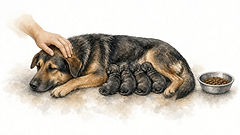
Painted illustration of eclampsia in a nursing dog

Eclampsia (Milk Fever)

Eclampsia, also called puerperal tetany or milk fever, is a life-threatening drop in blood calcium in nursing mothers.

Painted illustration of atopic dermatitis (environmental allergies) in a dog

Environmental Allergies

Atopic dermatitis is an inherited tendency to overreact to things in the environment, such as pollens, molds, and dust mites.

Painted illustration of a dog with a false pregnancy guarding toys

False Pregnancy

False pregnancy is when an unspayed female dog shows signs of pregnancy and mothering behavior after a heat cycle without actually being pregnant.

Painted illustration of heartworm disease in a dog

Heartworm

Heartworm disease is caused by a worm spread by mosquito bites.

Painted illustration of a hooded vulva in a dog

Hooded Vulva

A hooded or recessed vulva is partly hidden by surrounding skin folds.

Painted illustration of a liver tumor in a dog

Liver Tumors

Liver tumors can be benign or malignant; in dogs most primary liver tumors are malignant, with hepatocellular carcinoma the most common.

Painted illustration of mastitis in a nursing dog

Mastitis

Mastitis is inflammation, usually from infection, of one or more mammary glands.

Painted illustration of nuclear sclerosis in a dog

Nuclear Sclerosis

Nuclear sclerosis is a normal, age-related bluish-gray haze in the lens of the eye of middle-aged and older dogs.

Painted illustration of pododermatitis in a dog

Paw Inflammation

Pododermatitis means inflammation of the paws.

Painted illustration of a perineal hernia in a dog

Perineal Hernia

A perineal hernia happens when the muscles beside the anus weaken or tear, letting fat, intestine, or even the bladder bulge under the skin.

Painted illustration of prostate disease in an older male dog

Prostate Disease

Prostate problems are common in unneutered male dogs.

Painted illustration of cryptorchidism in a male puppy

Retained Testicle

Cryptorchidism is when one or both testicles do not descend into the scrotum.

Painted illustration of a dog waiting anxiously at the door

Separation Anxiety

Some dogs become distressed when left alone, barking, pacing, chewing exits, drooling, or soiling indoors.

Painted illustration of a skin tag in a dog

Skin Tags

Skin tags, also called fibroepithelial polyps or fibromas, are slow-growing, benign growths of fibrous tissue.

Painted illustration of an umbilical hernia in a dog

Umbilical Hernia

An umbilical hernia is a soft bulge at the belly button where the umbilical opening did not fully close after birth.

Painted illustration of vaginal hyperplasia in a dog

Vaginal Hyperplasia

In vaginal hyperplasia, swollen vaginal tissue pushes out through the vulva during heat.

Painted illustration of a tense dog showing warning body language

Aggression

Aggression in dogs ranges from a warning growl or snap to serious bites.

Painted illustration of bite wound care in a dog

Bite Wounds

Bite wounds are one of the most common reasons dogs need emergency care.

Painted illustration of canine brucellosis testing in breeding dogs

Brucellosis

Canine brucellosis is a contagious bacterial infection that mainly affects the reproductive system, causing late miscarriage and infertility.

Painted illustration of Cushing's disease in a dog

Cushing's Disease

Cushing's disease (hyperadrenocorticism) is overproduction of cortisol, the body's stress hormone.

Painted illustration of intervertebral disc disease in a dog

Disc Disease (IVDD)

In intervertebral disc disease, a degenerated spinal disc ruptures and presses on the spinal cord, causing back or neck pain, wobbliness, or paralysis.

Painted illustration of ear infections (otitis externa) in a dog

Ear Infections

Otitis externa is inflammation of the outer ear canal.

Painted illustration of ectopic ureters in a dog

Ectopic Ureters

Ectopic ureters are a birth defect in which the tubes carrying urine from the kidneys bypass their normal entry into the bladder.

Painted illustration of an eyelid margin tumor in a dog

Eyelid Tumors

Growths on the eyelid edge are common in dogs.

Painted illustration of a lipoma in a dog

Fatty Tumor (Lipoma)

A lipoma is a common, benign fatty lump, usually under the skin, in middle-aged and older dogs.

Painted illustration of hip dysplasia in a dog

Hip Dysplasia

Hip dysplasia is an inherited malformation of the hip joint during growth that leads to a loose joint and arthritis.

Painted illustration of hypothyroidism in a dog

Hypothyroidism

Hypothyroidism means the thyroid gland makes too little hormone, slowing the body's metabolism.

Painted illustration of lymphoma in a dog

Lymphoma

Lymphoma is a cancer of lymphocytes, a type of white blood cell.

Painted illustration of mitral valve disease in a dog

Mitral Valve Disease

Mitral valve disease is a gradual thickening and weakening of the valve between the left heart chambers, so blood leaks backward.

Painted illustration of obesity in a dog

Obesity

Obesity means carrying enough extra body fat to harm health.

Painted illustration of pemphigus in a dog

Pemphigus

Pemphigus is a group of autoimmune skin diseases in which the immune system attacks the connections between skin cells, causing crusts, sores, and sometimes blisters.

Painted illustration of periodontal disease in a dog

Periodontal Disease

Periodontal disease is an infection of the tissues that hold the teeth in place.

Painted illustration of pyometra in a dog

Pyometra

Pyometra is a serious, life-threatening infection of the uterus in unspayed female dogs.

Painted illustration of a healthy dog weeks after giving birth

SIPS (Bloody Discharge)

SIPS is long-lasting bloody discharge after giving birth, caused by slow healing of the uterus where the placentas were attached.

Painted illustration of a skin abscess in a dog

Skin Abscesses

An abscess is a pocket of pus, often caused by a bite or a penetrating object such as a stick or grass seed.

Painted illustration of a splenic tumor in a dog

Splenic Tumors

Tumors of the spleen can be benign (hemangioma) or malignant (hemangiosarcoma).

Painted illustration of urethral sphincter incompetence in a dog

Urinary Incontinence

USMI is a common cause of urine leakage in spayed female dogs: the muscles that keep the urethra closed lose tone, so urine leaks when the dog is relaxed or asleep.

Painted illustration of a young female dog with vaginitis

Vaginitis

Vaginitis is inflammation of the vagina or the area just inside the vulva.

Painted illustration of osteoarthritis in a dog

Arthritis

Osteoarthritis is a slowly worsening joint disease in which the protective cartilage wears down, causing pain, stiffness, and bony changes.

Painted illustration of bloat (GDV) in a dog

Bloat (GDV)

GDV is a life-threatening emergency in which the stomach fills with gas and twists, cutting off its entrance, exit, and blood supply.

Painted illustration of an older dog confused in a corner

Cognitive Dysfunction (Dementia)

Canine cognitive dysfunction is a slowly progressive, age-related decline in brain function, similar in some ways to Alzheimer's disease.

Painted illustration of diabetes mellitus in a dog

Diabetes

Diabetes occurs when the body doesn't make enough insulin, so sugar builds up in the blood instead of fueling cells.

Painted illustration of discoid lupus erythematosus in a dog

Discoid Lupus (DLE)

Discoid lupus erythematosus, sometimes called "collie nose," is an autoimmune skin disease that usually starts on the nose, causing loss of pigment, a smooth surface, crusts, and sores.

Painted illustration of ear margin vasculitis in a dog

Ear Tip Necrosis

Inflammation or clotting of the small blood vessels in the ear flap can starve the ear tip of blood, causing dark crusts, sores, and dead tissue at the edge of the ear.

Painted illustration of entropion in a dog

Entropion

Entropion is an inward rolling of the eyelid that lets hair rub on the eye, causing pain and corneal damage.

Painted illustration of a weak newborn puppy apart from its littermates

Fading Puppy Syndrome

Fading puppy syndrome describes puppies that seem normal at birth but gradually weaken and die in the first two weeks of life.

Painted illustration of dilated cardiomyopathy in a dog

Heart Disease (DCM)

Dilated cardiomyopathy is a disease of the heart muscle: the walls thin and weaken, the heart enlarges, and it can no longer pump blood well.

Painted illustration of a histiocytoma in a dog

Histiocytoma

A histiocytoma is a common, benign skin tumor of young dogs.

Painted illustration of immune-mediated hemolytic anemia in a dog

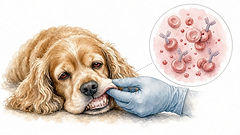
IMHA

In immune-mediated hemolytic anemia, the immune system destroys the dog's own red blood cells, often causing severe anemia.

Painted illustration of mast cell tumors in a dog

Mast Cell Tumors

Mast cell tumors are the most common skin cancer in dogs.

Painted illustration of a dog hiding during a thunderstorm

Noise & Storm Phobia

Fear of noises such as thunder and fireworks affects about a third of dogs.

Painted illustration of parvovirus in a dog

Parvovirus

Canine parvovirus is a highly contagious virus that attacks the intestinal lining and the immune system.

Painted illustration of perianal gland tumors in a dog

Perianal Tumors

Lumps around the anus in dogs are often perianal (hepatoid) gland tumors.

Painted illustration of a nursing dog and her puppies with a food bowl

Pregnancy Nutrition

Pregnancy and nursing put big demands on a mother dog.

Painted illustration of a dog after delivery with a retained placenta

Retained Placenta

A retained placenta is afterbirth that stays in the uterus after a puppy is born.

Painted illustration of a sebaceous adenoma in a dog

Sebaceous Adenoma

Sebaceous adenomas are common, benign growths of the skin's oil glands in older dogs.

Painted illustration of a skin cyst in a dog

Skin Cysts

Skin cysts in dogs are benign, keratin-filled sacs, most of which come from hair follicles.

Painted illustration of cruciate ligament rupture in a dog

Torn Cruciate (ACL)

The cranial cruciate ligament (similar to the ACL in people) stabilizes the knee.

Painted illustration of metritis in a dog after giving birth

Uterine Infection

Metritis is inflammation of the uterus, usually from bacterial infection, that develops after a dog gives birth.

Painted illustration of zinc-responsive dermatosis in a dog

Zinc Dermatosis

Zinc-responsive dermatosis is a skin disease caused by poor absorption or low availability of zinc.

bottom of page